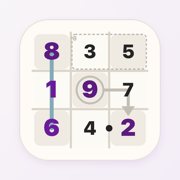
Between Line Sudoku: Rules & How to Solve
Every digit on the line lives strictly between the two circled bulbs. Simple to state, sneaky to solve.
The rule
Digits on a between line must fall strictly between the two digits in the circles at its ends. If the bulbs are 2 and 8, the line holds only 3–7.
How far apart must the circles be?
Every cell on the line must be strictly between the two circled endpoints. So the gap between the endpoints is what decides how many cells the line can carry: endpoints a and b leave only b − a − 1 usable digits, and the middle cells cannot repeat if they see each other.
| Endpoints | Gap | Middle cells it can carry | Digits available |
|---|---|---|---|
| 1 and 3 | 2 | 1 | 2 |
| 1 and 4 | 3 | 2 | 2, 3 |
| 1 and 5 | 4 | 3 | 2, 3, 4 |
| 1 and 6 | 5 | 4 | 2, 3, 4, 5 |
| 1 and 7 | 6 | 5 | 2, 3, 4, 5, 6 |
| 1 and 8 | 7 | 6 | 2, 3, 4, 5, 6, 7 |
| 1 and 9 | 8 | 7 | 2, 3, 4, 5, 6, 7, 8 |
Turn that around and it becomes a constraint on the ends: a three-cell line needs a gap of at least 4, so endpoints of 1 and 4 are already impossible. The longer the line, the further apart the circles are forced to be — which usually pushes one end toward 1 or 2 and the other toward 8 or 9.
VariantDoku shows the same reference inside the app: open any puzzle, tap the rules sheet, and each constraint on the grid gets its own tips card.
How to solve between line sudoku
Bulbs define the window
Wide bulbs (like 1 and 9) allow many line values; close bulbs force a narrow, often unique, set.
Count the cells
A long line needs a wide gap between the bulbs — a five-cell line can't sit between 4 and 6.
No equals
Line digits are strictly inside the bulb values, so they never equal either bulb.
Solve the ends first
The endpoints control everything. A line with three middle cells needs a gap of at least 4 between its circles, which often pushes one end to 1 or 2.
Middle cells are unordered
Unlike a thermometer, digits on a between line need not increase — they only need to fall between the two ends, in any order.
A worked example
Suppose a between line has three middle cells and one endpoint is known to be 3. The gap must be at least 4, so the other endpoint is at least 7 — immediately eliminating 4, 5 and 6 from that circle. If the other endpoint turns out to be exactly 7, the middle cells are forced to be {4,5,6} as a set.
Note the endpoints themselves are unordered: either circle may hold the larger digit. Look for a line whose ends sit in the same row, column or box — then they cannot be equal, and often only one orientation survives.
Frequently asked questions
- What is a between line in sudoku?
- A line whose digits all fall strictly between the two digits in the circles at its ends.
- Can a between line equal its bulb digits?
- No — the values are strictly between the bulbs, never equal to them.
- How does line length matter?
- Longer lines need a bigger gap between the bulbs to fit enough distinct values.
- Do the between line endpoints have to be in a particular order?
- No. Either circle may hold the larger value; the rule only says the middle cells fall strictly between them.
- Can a digit equal an endpoint?
- No. Middle cells must be <em>strictly</em> between, so a line running between 3 and 7 can use 4, 5 and 6 only.
Solve Between Line Sudoku on your iPhone
VariantDoku has a logic-checked catalog of Between Line Sudoku and dozens of other variants, with a fresh puzzle every day. No ads, no trackers.
Download on the App Store