Palindrome Sudoku: Rules & How to Solve
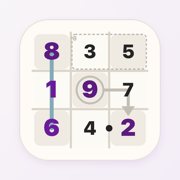
Each grey line reads the same forwards and backwards, mirroring digits across its centre.
The rule
Each palindrome line reads identically in both directions: cells equally spaced from the centre hold the same digit. The middle cell of an odd-length line can be anything legal.
Palindrome pairing table
A palindrome line reads identically in both directions, so cell 1 equals the last cell, cell 2 equals the second-to-last, and so on inward. The useful consequence is that a palindrome teleports a digit: two cells far apart, in different rows, columns and boxes, are forced to be equal.
| Line length | Mirrored pairs | Centre | Pairing |
|---|---|---|---|
| 2 | 1 | none | 1=2 |
| 3 | 1 | 1 free centre cell | 1=3 |
| 4 | 2 | none | 1=4, 2=3 |
| 5 | 2 | 1 free centre cell | 1=5, 2=4 |
| 6 | 3 | none | 1=6, 2=5, 3=4 |
| 7 | 3 | 1 free centre cell | 1=7, 2=6, 3=5 |
| 8 | 4 | none | 1=8, 2=7, 3=6, 4=5 |
| 9 | 4 | 1 free centre cell | 1=9, 2=8, 3=7, 4=6 |
Odd-length palindromes have a middle cell with no partner — it is unconstrained by the palindrome rule and takes its value from normal sudoku logic alone.
VariantDoku shows the same reference inside the app: open any puzzle, tap the rules sheet, and each constraint on the grid gets its own tips card.
How to solve palindrome sudoku
Pair the mirrors
The first and last cells match, the second and second-to-last match, and so on — solve one, get its twin free.
Mind the line's path
A palindrome that bends through two boxes links cells you'd never otherwise connect.
Length parity
Even-length palindromes have no free centre; odd-length lines leave the middle cell unconstrained by the mirror.
Look for pairs sharing a house
If two mirrored cells land in the same row, column or box, the shape is contradictory — they would have to be both equal and different.
Treat mirrors as free copies
Solving one end of a mirrored pair solves the other for nothing, often placing a digit in a box that had no other route to it.
A worked example
The strongest palindromes are the ones that fold back into the same house. If a mirrored pair lands in the same row, column or box, the two cells must be equal and must differ — a contradiction. That instantly rules the shape out, or in a set puzzle tells you the line cannot pass where you assumed.
Otherwise, use them as copies: solve either end of a pair and the other end is free. A six-cell palindrome gives you three such copies, which often carries a digit across the grid into a box that had no other way to place it.
Frequently asked questions
- What is a palindrome line in sudoku?
- A marked line whose digits read the same forwards and backwards, so symmetric cells are equal.
- Do palindrome cells repeat digits?
- Mirrored cells share a value, but the usual row, column, and box rules still prevent illegal repeats.
- What about the centre cell?
- On an odd-length line the centre is its own mirror, so it's free apart from normal rules.
- Does a palindrome line have to contain distinct digits?
- No. Mirrored cells are deliberately equal — the line repeats by design, subject only to normal sudoku rules on the cells themselves.
- What happens to the middle cell of an odd palindrome?
- Nothing. It has no mirror partner and is constrained only by ordinary sudoku logic.
Solve Palindrome Sudoku on your iPhone
VariantDoku has a logic-checked catalog of Palindrome Sudoku and dozens of other variants, with a fresh puzzle every day. No ads, no trackers.
Download on the App Store