Renban Sudoku: Rules & How to Solve
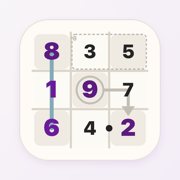
Each purple line is a set of consecutive numbers in any order. Flexible, fast, and great for chaining.
The rule
Digits on a renban line form a set of consecutive numbers in any order, with no repeats. A three-cell renban could be 4-6-5 or 7-5-6, but always a run.
Renban run table
A renban line holds a set of consecutive digits in any order, with no repeats. So a line of length L has only 10 − L possible sets — and the longer the line, the fewer choices remain.
| Line length | Possible runs | The runs |
|---|---|---|
| 2 | 8 | {1,2}, {2,3} … {8,9} |
| 3 | 7 | {1,2,3}, {2,3,4} … {7,8,9} |
| 4 | 6 | {1,2,3,4}, {2,3,4,5} … {6,7,8,9} |
| 5 | 5 | {1,2,3,4,5}, {2,3,4,5,6} … {5,6,7,8,9} |
| 6 | 4 | {1,2,3,4,5,6}, {2,3,4,5,6,7}, {3,4,5,6,7,8}, {4,5,6,7,8,9} |
| 7 | 3 | {1,2,3,4,5,6,7}, {2,3,4,5,6,7,8}, {3,4,5,6,7,8,9} |
| 8 | 2 | {1,2,3,4,5,6,7,8}, {2,3,4,5,6,7,8,9} |
| 9 | 1 | {1,2,3,4,5,6,7,8,9} |
A nine-cell renban is fully determined as a set: it is 1–9 in some order, which makes it behave like an extra region.
VariantDoku shows the same reference inside the app: open any puzzle, tap the rules sheet, and each constraint on the grid gets its own tips card.
How to solve renban sudoku
Length fixes the spread
A four-cell renban spans exactly four consecutive values, so it can't contain both a 1 and a 9 — the extremes are bounded.
Order is free
Unlike a thermometer, renban cells can be arranged any way, so use crossing constraints to pin the order.
Intersect with boxes
Renban lines that stay inside one box can't repeat anyway; the value comes from which consecutive run fits the remaining candidates.
Use the length to bound the extremes
On a line of length L the smallest digit is at most 10 − L and the largest is at least L. A six-cell renban must therefore contain both 5 and 6.
Renbans behave like mini-regions
Because a renban never repeats, any cell that sees the whole line cannot hold any digit on it. Short renbans sitting inside a single box are especially strong.
A worked example
Anchor on the extremes. If a five-cell renban contains a 1, the only run that fits is {1,2,3,4,5} — the line is fully known as a set, and every one of those digits is eliminated from any cell that sees the whole line. A 9 on the same line forces {5,6,7,8,9} instead.
Middle digits are weaker but still useful: a 5 on a five-cell renban leaves five candidate runs, but every one of them contains 5, 4-or-6, and so on — enough to prune the extremes.
Frequently asked questions
- What is a renban line?
- A line whose cells hold a set of consecutive digits in any order, with no repeats.
- Can a renban line repeat digits?
- No. The set is consecutive and distinct, like {5,6,7}.
- How is renban different from a thermometer?
- Both use consecutive runs, but a thermometer is strictly ordered low-to-high while a renban can be in any order.
- Does the order matter on a renban line?
- No. A renban holds consecutive digits in <em>any</em> order — the set is constrained, the sequence is not.
- Can a renban line repeat a digit?
- No. The digits form a set of consecutive values with no repeats, regardless of whether the cells see each other.
Solve Renban Sudoku on your iPhone
VariantDoku has a logic-checked catalog of Renban Sudoku and dozens of other variants, with a fresh puzzle every day. No ads, no trackers.
Download on the App Store