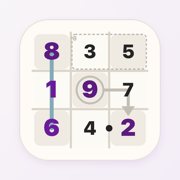
Anti-Knight Sudoku: Rules & How to Solve
No digit repeats a chess knight's move away. A spatial constraint that reshapes how the whole grid connects.
The rule
Identical digits may not be a chess knight's move apart (two cells in one direction and one cell perpendicular). All normal sudoku rules also apply.
The eight knight offsets
After you place a digit, that digit is banned from all eight cells a chess knight could reach. Checking them is mechanical — these are the offsets, in rows and columns, from the cell you just filled:
| Row offset | Column offset |
|---|---|
| -2 | -1 |
| -2 | +1 |
| -1 | -2 |
| -1 | +2 |
| +1 | -2 |
| +1 | +2 |
| +2 | -1 |
| +2 | +1 |
A cell in the middle of the grid has all eight neighbours; a corner cell has only two. That is why the anti-knight constraint bites hardest in the centre and does very little in the corners — the opposite of most variant rules.
What the rule does not say
Anti-knight says nothing about diagonals. Two cells touching diagonally may absolutely hold the same digit unless ordinary sudoku forbids it — that is the anti-king rule, a different constraint. Mixing the two up is the most common mistake on these grids.
VariantDoku shows the same reference inside the app: open any puzzle, tap the rules sheet, and each constraint on the grid gets its own tips card.
How to solve anti knight sudoku
Map the eight attacks
Each cell has up to eight knight-move neighbours — placing a digit forbids it in all of them.
Great for the middle
Central cells reach the most neighbours, so anti-knight logic bites hardest there.
Combine with boxes
A digit already in a box plus its knight exclusions often leaves a single legal cell elsewhere.
Sweep eight cells after every placement
Each placed digit bans itself from up to eight knight-move cells spread across three boxes — the eliminations reach much further than a normal sudoku placement.
Centre cells carry the constraint
A central cell has all eight knight neighbours; a corner has two. Expect the rule to do its work in the middle of the grid, not the edges.
A worked example
The rule is at its most powerful on digits that are nearly placed. If a box has only two candidate cells left for its 7, check whether either of them sits a knight's move from an existing 7 — very often one does, and the box resolves without any other logic.
It also chains. Placing a 4 removes 4 from up to eight cells scattered across three different boxes, which is why anti-knight puzzles tend to unravel in bursts: one placement cascades outward instead of tightening a single house.
Frequently asked questions
- What is anti-knight sudoku?
- A sudoku where cells a chess knight's move apart cannot share the same digit.
- How many knight-move neighbours does a cell have?
- Up to eight, fewer near the edges and corners of the grid.
- Does anti-knight replace normal rules?
- No, it adds to them — rows, columns, and boxes still each hold 1–9.
- Does anti-knight stop digits repeating diagonally?
- No. Diagonal adjacency is the <em>anti-king</em> rule. Anti-knight only forbids repeats a chess knight's move apart.
- How many cells does a knight's move reach?
- Up to eight, fewer near the edges. A corner cell has just two knight neighbours, which is why corners stay loose on these grids.
Solve Anti-Knight Sudoku on your iPhone
VariantDoku has a logic-checked catalog of Anti-Knight Sudoku and dozens of other variants, with a fresh puzzle every day. No ads, no trackers.
Download on the App Store